Communications networks encompass a wide range of applications. Telephony, in particular, is one of the most widely used communication networks in today's society. Its operation, evolution, characteristics, and future are of crucial importance to students specializing in digital telecommunications.
- Teacher: OMAR MAHRI
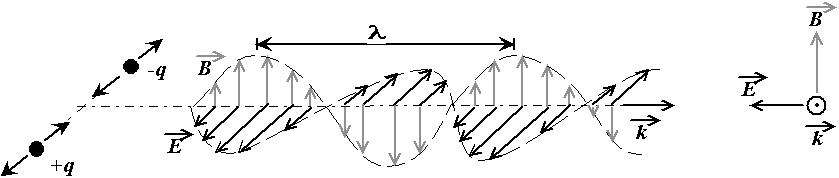
Any long-distance transmission chain using radio waves employs electromagnetic waves. These waves tend to be affected by the propagation medium. It is therefore necessary to know how to study these electromagnetic waves, to be able to model and characterize them, taking into account the specific characteristics of the media through which they propagate.- Teacher: AHCENE BOUALLEG
Communication Systems and Networks study how information is transmitted, processed, and exchanged between devices over various media. The course covers signal representation, modulation, and the effects of noise on communication quality. It also introduces network architectures, protocols, and methods that enable reliable data exchange. Together, these concepts form the foundation of modern digital communication and interconnected systems.
- Teacher: SAMIR IKNI
Communication Systems and Networks study how information is transmitted, processed, and exchanged between devices over various media. The course covers signal representation, modulation, and the effects of noise on communication quality. It also introduces network architectures, protocols, and methods that enable reliable data exchange. Together, these concepts form the foundation of modern digital communication and interconnected systems.
- Teacher: SAMIR IKNI

This course provides a comprehensive introduction to digital signal processing (DSP), grounded in signal theory and its applications in spectral analysis and digital filtering. Key topics include Fourier analysis, convolution, random processes (e.g., Gaussian, Poisson), and noise modeling. Students will explore the design and analysis of analog filters, principles of signal sampling and quantization, and core discrete transforms such as the DFT, FFT, and Z-transform. The course balances theoretical foundations with practical tools for analyzing both deterministic and random signal
- Teacher: DJEDOUANI NADA

Sensors are used in almost every industry for a wide variety of applications—some of which we take for granted in our everyday lives. These devices are found in residential homes, offices, vehicles, medical facilities and equipment, manufacturing industries, and power plants.
Measurement sensors are so versatile and ubiquitous that today’s article will cover what they are and how measurement sensors are commonly used. We’ll also touch upon different applications.
- Teacher: DJEDOUANI NADA