
Course Description:
This course strengthens students' command of English grammar. Learners will examine the relationship between grammatical form and communicative function, progressing from core sentence structures and verb systems to advanced syntactic units such as non-finite clauses and complex noun phrases. By integrating morphological awareness with rigorous syntactic practice, the course enables students to analyse language accurately and deploy a wide range of complex grammatical forms in their language use.
Course Objectives:
By the end of this course, students will be able to:
- Distinguish between grammatical form and communicative function across diverse sentence types and syntactic structures.
- Master complex sentence architecture, including finite/non-finite clauses, relative clauses, prepositional phrases, and complex noun phrases.
- Apply precise mechanics in subject-verb agreement, tense-aspect systems, conditionals, and active/passive voice transformations.
- Select and deploy advanced grammatical forms to write clear, cohesive, and stylistically refined academic texts.
- Expand academic vocabulary and precision through morphological parsing and functional language patterns.
- Teacher: AMINA SELLAMI
Linguistics 1: Course Description
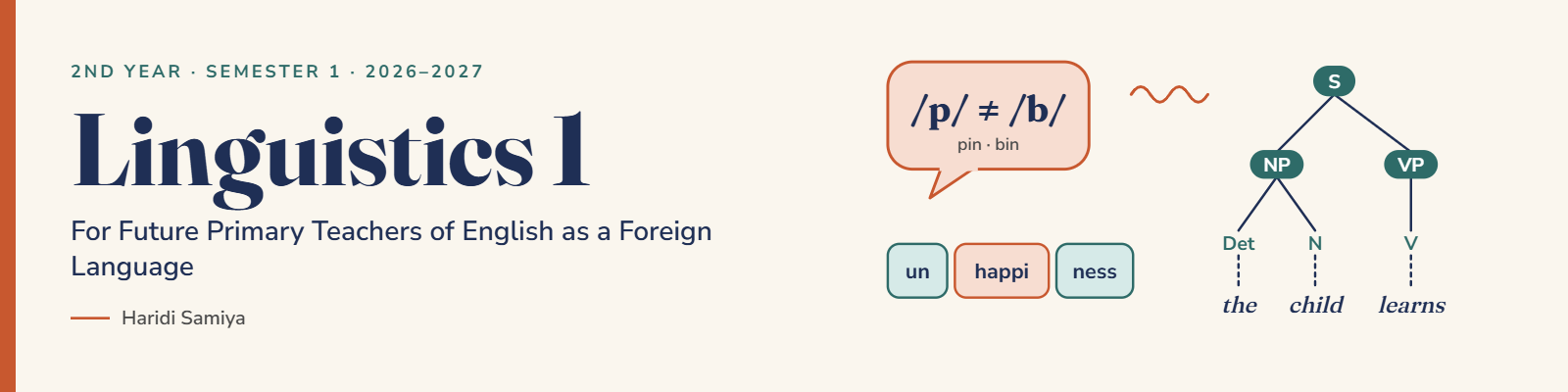
This course traces the development of linguistic thought, from traditional grammar and historical linguistics to structuralism, behaviorism, and Chomsky's generative grammar. Students analyze real language data using concepts from phonology, morphology, syntax, and semantics, and compare how each school explains language. The course also links theory to teaching practice, preparing future teachers to think critically about how ideas about language shape the way English is taught.
By the end of the semester, students will be able to:
- Explain the evolution of linguistic thought from traditional grammar to early generative linguistics.
- Identify and describe the major linguistic schools: structuralism, behaviorism, and generative grammar.
- Analyze linguistic data using concepts from phonology, morphology, syntax, and semantics.
- Compare and contrast different linguistic approaches to language structure and meaning.
- Apply linguistic theories to the interpretation of authentic language examples.
- Develop analytical and critical thinking skills in linguistic inquiry.
- Teacher: SAMIYA HARIDI