- Teacher: KHALED HALIMI
- Teacher: SAMIR HALLACI
Notes (Course Objectives)
Introduce students to the essential mathematical bases for digital information processing. Understand the time frequency duality critical for signal analysis. Quantify information using concepts like Entropy for coding efficiency.
Targeted Skills
➢ Understand the principles of digital information acquisition.
➢ Master techniques for signal processing and storage.
➢ Apply mathematical tools to the transmission of digital data (image,
sound, video)..
- Teacher: NADIA GUERROUI
- Teacher: AMINA ZEDADRA
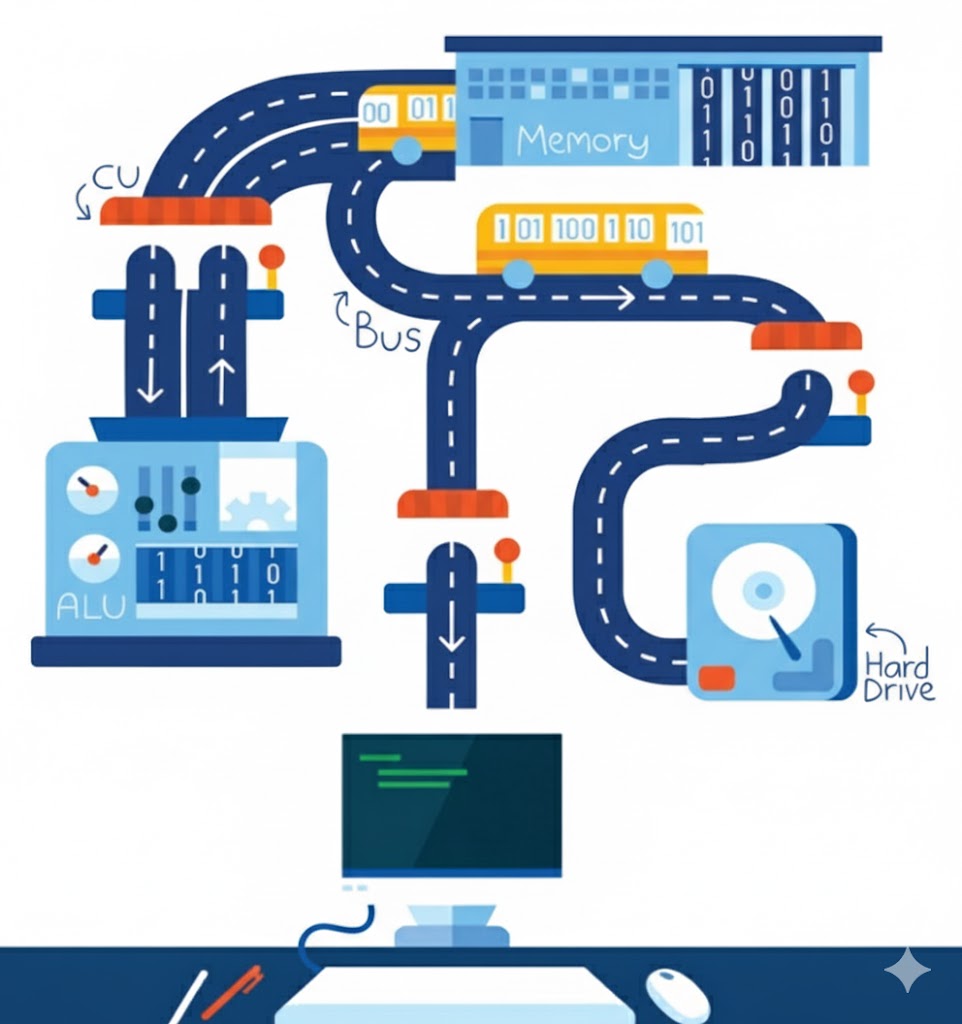
This course, designed for first-year undergraduate students in the Networks and WEB technologies, introduces the fundamentals of how computers function at both hardware and system
levels. Students will explore the basics of computer architecture, focusing on the CPU, memory,
and I/O devices, as well as understanding the fetch-decode-execute cycle. The course covers
assembly language programming for the x86-64 architecture using NASM, allowing students to
directly manipulate hardware resources through operations such as data movement, arithmetic,
and control flow. In addition, the course emphasizes the use of the Linux shell as a key tool
for interacting with the operating system. Students will learn to navigate the Linux filesystem,
execute commands, and develop shell scripts for automating tasks, configuring servers, and
performing system administration. By the end of the course, students will be able to write
and execute basic assembly programs, use the Linux shell for system interaction, and manage
Linux-based servers through shell scripting, mastering critical skills in system configuration
and administration. This foundation prepares students for further studies in networking, web
technologies, and system management.
- Teacher: NABIL BERREHOUMA