Programming in C remains one of the most fundamental skills in computer science and
engineering. Despite the rise of many modern languages, C continues to serve as the foundation
upon which countless technologies are built from operating systems and embedded systems
to compilers and real-time applications. Learning C is not merely about mastering a language;
it is about understanding how computers truly work.
This book, “Mastering C Programming: From Basics to Advanced Concepts,” is designed
as a complete and practical guide for beginners, students, and professionals seeking to
strengthen their programming foundations. It takes a gradual, example-driven approach,
introducing concepts step by step from variables, loops, and functions to more advanced
structures like pointers, recursion, data structures, and file handling.
Each chapter builds upon the previous one, with clear explanations and practical code examples
to reinforce understanding. Readers will find detailed coverage of essential topics such as
arrays, structures, enumerations, stacks, queues, trees, searching, and sorting algorithms,
as well as file input/output operations all explained in a concise yet comprehensive
manner.
By the end of this book, readers will not only be able to write efficient C programs but also
develop a deeper appreciation for algorithmic thinking and low-level computing principles.
Whether you are a student preparing for academic courses, a developer revisiting the roots of
programming, or an enthusiast eager to explore how software interacts with hardware, this book
will serve as a valuable and lasting resource on your programming journey.
By the conclusion of this text, the reader will have acquired a comprehensive understanding of
C as both a procedural and system-level language. Furthermore, the skills and problem-solving
techniques gained through this study will serve as a solid foundation for exploring advanced
programming paradigms, including object-oriented, parallel, and low-level system
development.
It is the author’s (Dr. Hallaci Samir) hope that this work will contribute meaningfully to the
teaching and learning of computer programming, and will inspire students to pursue further
studies and research in the discipline of computer science.

Notes (Course Objectives)

Introduce students to the essential mathematical bases for digital information processing. Understand the time frequency duality critical for signal analysis. Quantify information using concepts like Entropy for coding efficiency.

Targeted Skills

➢ Understand the principles of digital information acquisition.
➢ Master techniques for signal processing and storage.
➢ Apply mathematical tools to the transmission of digital data (image,
sound, video)..


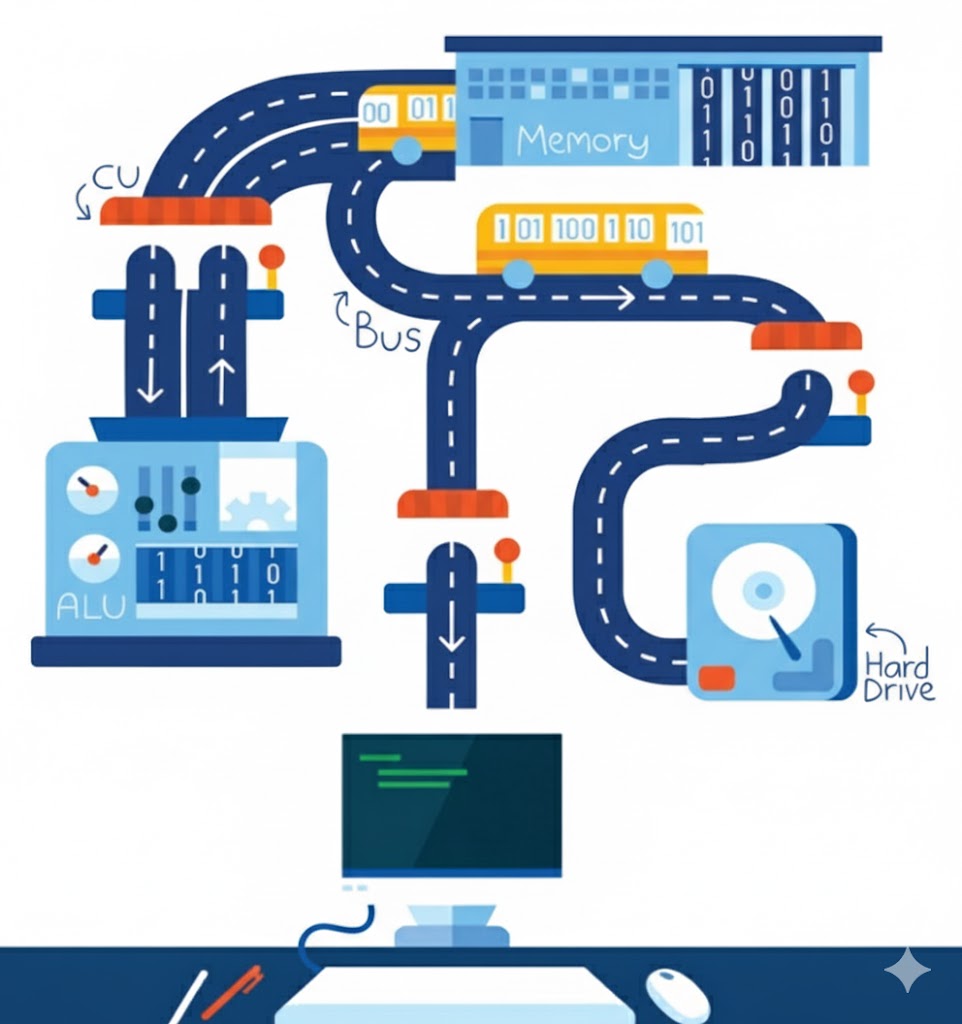
This course, designed for first-year undergraduate students in the Networks and WEB technologies, introduces the fundamentals of how computers function at both hardware and system levels. Students will explore the basics of computer architecture, focusing on the CPU, memory, and I/O devices, as well as understanding the fetch-decode-execute cycle. The course covers assembly language programming for the x86-64 architecture using NASM, allowing students to directly manipulate hardware resources through operations such as data movement, arithmetic, and control flow. In addition, the course emphasizes the use of the Linux shell as a key tool for interacting with the operating system. Students will learn to navigate the Linux filesystem, execute commands, and develop shell scripts for automating tasks, configuring servers, and performing system administration. By the end of the course, students will be able to write and execute basic assembly programs, use the Linux shell for system interaction, and manage Linux-based servers through shell scripting, mastering critical skills in system configuration and administration. This foundation prepares students for further studies in networking, web technologies, and system management.